


Meeting Us in a Design Center
In the past, some builders have been reluctant to let security companies meet directly with their customers. Ranger Technology Solutions has years of experience working with some of the most prominent builders in North Texas. We’ve learned how to work with the builder and the customer providing a mutually beneficial relationship.
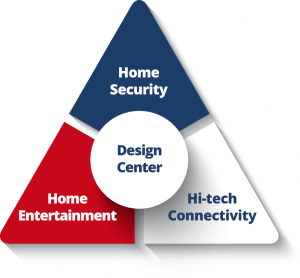
After the buyer signs the builder’s contract, they are told by their sales rep they will be meeting with Ranger Technology Solutions in the Design Center to select products and locations of those products using the floor plan selected. We will discuss three primary areas: Home Security, Entertainment and Hi-tech Connectivity. The items covered will include low voltage wiring options, lighting selections, electrical outlet locations, phone jack and networking outlet locations, media room layout, audio speaker placement, security system products, outside lighting, surround sound wiring, internet connections and more. Don’t underestimate the need for discussions on these items. You can do these items after construction but the finished product won’t look as good and is much easier (and less costly) to accomplish during construction.
We will take the time to sort out all these issues with you and come up with a firm design to meet your budget and lifestyle.
Ten Things to Know Before Going to New Home Design Center Appointments
As soon as buyer signs the new builder contract, they are told by Sales reps to setup design center appointment quickly to select their options for their new home. The problem, Buyers are not really ready. They just went through a decision making process to finalize the builder and plans and now they have to go through another daunting process to select the options. But they don’t have a choice as they have to complete the option selection before start of the home.
Usually builders provide 2-3 weeks time to complete the design center appointment which might seem like a lot of time, but it is not. Buyers also should understand design center appointments are crucial for getting the dream home the way you wanted. I have compiled a few tips which should help Buyers to get them prepared for the design center appointment and also guide them to be on budget.
- First things first, put a list of things which you really want and need separately to have in the house other than standard features provided by the builder. For example, Tile in family room. Is it a must now or you can upgrade later? Wood flooring, carpet upgrades, fireplace stones, power outlets etc., Also put a budget or number towards the total upgrades you want to add on top of builder incentives.
- In order to make the above list, it would be beneficial to find out what the builder’s standards look like. Most of builders allow you to go and check out the options provided either online or personally at the design center before your appointment. Also you can ask for the model home in and around town for your same plan and try to visit to get an idea of how they look in the plan. You can also ask for the option addendum for those houses and see if any other options would be of your interest.
- If you have an option to split the appointment hours, do it. Don’t use all the hours at one time. Make 2 appointments if possible which will help a lot. First appointment to go through the options provided both standard and upgrades and pricing and second appointment to finalize.
- After you’ve been to your first appointment, revise your list and take time to visit inventories and houses which are about in order to complete for your floor plan. Builder/Sales rep should help you in finding and giving you the address for them. Check out the upgrades you want and how it looks and make decision accordingly.
- Don’t underestimate the need of smaller items which helps to keep your house clean and look organized. For example, pre-wiring for security sensors,pre-wiring for speakers, pre-wiring for TV wall mounts, getting gas hookup or water softener loops, power outlets in places like floor, walls etc. You can do these things after construction, but it won’t look as good.
- Stick to your budget like you don’t want to go over $10k in upgrades even though you are tempted to do so by your design consultant. It might be a difficult task because most of the standard options provided by builders won’t look good and you are forced to upgrade them. In that case, you can use the next tip.
- If the granite countertop is not the color you wanted and upgrading is expensive, try the complement approach. Try to upgrade just one of these items to get the coloring the way you wanted. Avoid upgrading both unless really necessary.
- Get only very important items upgraded and get standards for those which can be upgraded later after construction. For example, you can always change to tile flooring from carpet later but changing cabinets is not easy to do. You cannot add gas outlets in the back yard after construction so you should add it for future use.
- In the second appointment, try to stick with your finalized list and don’t try to add anything more. First make sure you have everything you wanted to make the house look good and is worth the money that you are spending. iIf you have a lot of money to do upgrades put it to good use for improvements which adds overall value to the house. For example, you can increase your ceiling plate which many builders provide for $1000 or $1500. You can also add stone elevation instead of a back patio which can be added at a later time.
- Finally, don’t make changes after design center appointments as they won’t come cheap. Make all your changes when you meet with your Sales Rep after the Design appointment, because after that most builders will charge change order fees to make any changes.
In Summary, compile your needs vs. wants list as well as a reasonable budget and try to stick with it by adding essential upgrades and not going overboard.
I know it’s not an easy task when it comes to decision making and it gets even tougher when two humans with different brain structures is involved. Try to enjoy these appointments by working together by coming up with an unified list to build your dream home.
“Berber carpeting would be nice. Tile floors in my new kitchen. Perhaps some “surround sound” speakers in the family room. Oh, yes, a central vacuum! A friend of mine has that in their house and they just love it.”
You’re about to take the plunge. Your new home is beginning to become more than just a pipe dream. It’s time to take the trek to the builder’s design center for those all-important upgrades selections. How can you prepare yourself, mentally, emotionally, and financially for this experience? What should you expect from this meeting?

This is an exciting time for you.
Many buyers look at the design center appointment as one of the more enjoyable steps in the process of buying a new home. There are several ways to prepare yourselves for this experience, with the help of your sales consultant and some pre-planning. If your plan is to go with the builder’s included flooring, fixtures, and countertops, chances are you will have a limited number of items to choose from, and the process should go rather quickly. Carpeting included in the price for most new homes is of the “apartment” variety, with minimal or no stain resistance, tends to be light in weight (yarns per square inch) and show wear quicker than the upgraded, heavier varieties. Buyers who opt for standard carpet may wish to upgrade their carpet pad, which may permit their carpeting to last longer. It will also be in place should you decide to opt for a higher grade carpet later on. Other “standard” flooring in today’s production homes usually include some tile in the entry foyer and vinyl in bathrooms, kitchen and laundry areas. Counter top surfaces can vary greatly from builder to builder, as will the type and style of lighting fixtures indoor and out. Ask your sales consultant to walk you through the models and point out any included builder features, so you’ll know what to expect. Whenever possible, get a list of as many of the potential options and upgrades that will be available to you through the builder’s design center. Sometimes these lists lack pricing, but some builders will have listed prices for each item. Try to determine whether the pricing you see is what you would be paying at deposit time, as pricing for upgrades can be rather static. If something within the model home or inventory home you have been shown has some special feature that really hits your fancy, but you find it difficult to describe, take your video camera along. A picture is worth a thousand words.
If you have pre-determined the maximum amount you are willing to spend on upgrading your house, use this preliminary list as your guide, and prioritize items with a color-coded system.
Highlight the “can’t live without” items first, the “next in priority” items in a second color, and the “maybe if I stretch it” items with, perhaps, blue (for “once in a blue moon”).
After checking with your lender, you may be surprised to find out that an extra $1,000 in upgrades may only add about $7 per month to your monthly house payment. If you don’t have a problem qualifying for a bit extra, it may be well worth it to get that granite countertop for your kitchen or the Jacuzzi tub you may picture yourself soaking in after the boxes are unpacked. Electrical options, landscape or patio options, and plumbing extras (laundry tub, Jacuzzi, instant hot water, etc.) may be included in the design center appointment as well. Options of this kind during the construction of your new home are becoming more and more popular, as two income households have less and less time to devote to ‘do it yourself’ home enhancement these days. Many builders may charge up-front non-refundable administrative fees for special requests for non-standard pricing from their buyers, and most now do charge a similar fee for changing your mind after having selected and signed for your upgrades. As with any business operation, the time and manpower devoted to a revision or special request, with its inherent paper trail and communication to the builder’s field personnel can be costly. If the home you selected was under construction at the time you agreed to purchase it, there will be cut-off times for electrical, plumbing, construction options (den or bonus rooms, 3 or 4 car garage, for example), door and window changes, to name a few. A production home is continuously being built, which means the proper sub-contractors are scheduled weeks and even months in advance.